Northwest TerritoriesNature & scenery
Yellowknife Northern Lights Viewing Tour
A guided evening outside the city for the best chance of seeing the aurora.
Aurora tours from Yellowknife take you by vehicle from the city to a dark, heated viewing site for an evening of watching the sky. The season runs from mid-August to April. Clear skies matter most, and the lights are never guaranteed, so plan more than one night if you can.
An aurora tour is an evening outing. A guide collects you from your hotel, drives you away from the city lights to a viewing site and stays with you while you watch the sky. Our listed tour runs about four to five hours.
The viewing site usually has a heated shelter, warm drinks and somewhere to sit when you need a break from the cold. Guides watch the sky and the clouds, can adjust the location if the weather changes, and often help with photographs. You spend much of the time waiting, which is part of the experience.
The evening often begins after dinner and continues past midnight, because the aurora can appear at different times. Plan to stay flexible and rest during the day. Ask the operator about the usual departure time and the typical return time to your hotel.
Yellowknife sits beneath the aurora oval, a ring around the geomagnetic pole where displays are most frequent. It is also reachable by air and has the services visitors need, such as hotels, restaurants and experienced operators.
Being under the oval means the aurora can appear directly overhead rather than low on the horizon. That does not mean every night is spectacular. The lights are a natural phenomenon and no operator can promise them.
Yellowknife is on the shore of Great Slave Lake, and its flat, open surroundings offer wide views of the sky. The combination of dark skies, clear and dry northern air and a location under the oval is what makes it a popular destination for aurora travellers.
The aurora happens year-round, but the northern summer sky is too bright to see it. The season for viewing runs from mid-August to April, once the nights get properly dark.
Late summer and early autumn are milder, and open lakes can reflect the sky. Winter brings longer nights and deep cold, with snow and ice. Many visitors choose between comfort in the shoulder months and the classic winter atmosphere, and either can work.
If you are sensitive to extreme cold, consider the shoulder months of late August, September and early October or March and April. Temperatures are milder, although the nights are shorter in spring, so check the darkness hours with your operator.
Cloud is the biggest factor, because the aurora cannot be seen through thick cover. A clear sky can give a good show even when activity is modest. A bright full moon can wash out faint displays, while the nights near a new moon are darker, although strong aurora can still stand out under a moon.
Online forecasts of solar activity are interesting but limited, especially at high latitudes where displays happen on many nights. A guide’s judgement on the day, based on cloud movement and the sky itself, is more useful than a single number. Treat all forecasts as hints.
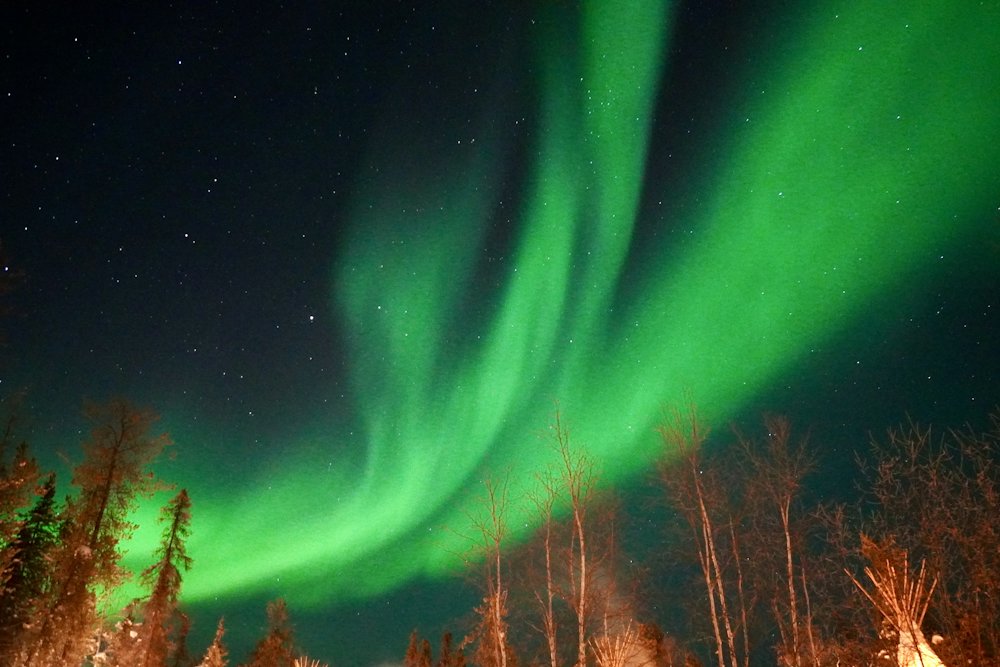
The aurora can vary from a faint grey arc to moving green curtains with hints of purple or pink. A camera often shows more colour than the eye sees at first, so a pale display is not necessarily a disappointing one.
The best way to improve your chances is to give yourself several evenings. One night can be cloudy even in a good season, and a second or third night greatly increases the odds of a clear sky. Our tour page recommends scheduling more than one evening where possible.
Spread your evenings over consecutive nights, with something relaxing planned for the days. Staying up late is tiring, so avoid placing a long flight or a demanding day the morning after. Multiple-night options can be arranged through the quote.
Aurora tours differ in group size and style. A larger group is usually less expensive per person, and a small or private group allows more flexibility if the guide wants to move to a clearer patch of sky. Heated shelters with seating are valuable in deep winter.
Ask how many people the group holds, how long you are expected to stay outside and whether there is somewhere to warm up. Also ask whether the operator will re-locate in response to clouds, and how the day’s decision is made. These details shape your comfort more than the name of the tour.
Winter nights in Yellowknife are often well below minus 20 and can be colder. Wear thermal base layers, an insulating middle layer and a parka. Add insulated boots, warm socks, a hat that covers your ears, a neck warmer or balaclava, and mittens, which are warmer than gloves.
Standing still for hours is colder than moving. Hand and foot warmers help, and loose layers trap more heat than tight ones. Ask your operator whether cold-weather gear can be provided, because some do and it saves packing a heavy parka.
Avoid tight boots, since they restrict circulation and make feet colder. Put hand warmers inside your mittens before you head out, and keep your phone in an inside pocket until you need it. Dress warmly even for shoulder-season evenings, because the temperature drops quickly after dark.
You can photograph the aurora with a camera or a recent phone. Use a tripod or a stable surface, because exposures last several seconds. On a camera, use manual mode, a wide lens, a wide aperture, a high ISO and a long exposure, then adjust based on the brightness.
On a phone, use night mode and keep it still. Cold drains batteries quickly, so keep spares warm inside your jacket. Bring a camera back indoors in a sealed bag so condensation forms on the bag, not the lens. Put the camera down occasionally and watch the sky with your own eyes.
Practice before the trip. Learn how to switch your camera to manual mode and adjust focus on a distant star or light, since autofocus struggles in the dark. A remote shutter or a two-second timer prevents shake.
Aurora evenings leave your days free. Many visitors rest, walk Old Town, see the Great Slave Lake waterfront, or visit local museums and shops. In deep winter, daylight is short, so plan indoor options too.
Be realistic. You might see a faint glow, a spectacular display or nothing. Weather and solar activity decide. BookTours.ca arranges tours via independent local operators, replies by email and provides itemised quotes in Canadian dollars, so ask about timing, clothing and what happens if the weather is poor.
If this is the main reason for your trip, treat the aurora as a bonus on top of an enjoyable northern stay rather than a promise. Travellers who give themselves several nights, dress well and keep an open mind are usually the happiest.
The viewing season runs from mid-August to April. Within that, the best night is simply a clear one, so plan several evenings.
No. The aurora is a natural event that depends on solar activity and clear skies, and no operator can promise it. Multiple nights improve your chances.
More is better. One night can be cloudy, and two or three evenings noticeably increase the chance of a clear sky.
Winter nights are often well below minus 20 and can be colder. Wear a parka, insulated boots, mittens and face protection, and ask whether the operator provides cold-weather gear.
Yes, with a recent phone using night mode and a steady surface or small tripod. Keep spare batteries warm, since cold drains them quickly.
Tell us your dates and group size and we will email an itemised quote. Free, no obligation, no online payment. Request a quote
Northwest TerritoriesNature & scenery
A guided evening outside the city for the best chance of seeing the aurora.
YukonHistory & culture
The Yukon River, gold rush history and northern wilderness near Whitehorse.